Delayed Reaction
The Iranian filmmaker Abbas Kiarostami once said that he preferred films that put their audience to sleep in the theater, because those same films had kept him awake for weeks afterward. It's a provocative notion, but one that I’ve experienced firsthand myself. The film that holds you hostage with stimulus, that delivers its feeling on schedule and sends you home satisfied, is often the one that vanishes most completely once it's over, because the intended feelings found their exit. The film that withholds instruction, that declines to tell you what to feel or when, that leaves questions lingering and unanswered, instills itself cryptically in the subconscious, and does its real work later. These films don’t leave you alone after the credits roll, they demand processing in the same way life experiences do, through reflection, conversation, and emotional reckoning, often involuntarily.
There is a reason most movie-going audiences expect satisfactory endings, and leave the theater frustrated or enraged when deprived of that. Before cinema, before performance art, or even the written language, human beings have always gathered to hear stories. The skilled storyteller occupied a specific and necessary function for the survival of the village, tribe, or family. They were not merely entertainers, but something closer to emotional managers. A community accumulates feelings through difficulty, loss, fear, desire, disagreements, and in the midst of their confusion and consternation, crave understanding and relief. Story gave that accumulated tension somewhere to go, it provided explanations for mysterious questions, guidance in the face of unresolved problems, motivation for the downtrodden to persist. Cinema inherited this function at a societal or even global scale. The tools have evolved, but the fundamental choices of the storyteller are the same. How long to dwell on a moment, and what style of description to employ. How drastically should the emotional emphasis vary. Whether to build anticipation for a specific outcome, and then how to pay it off. What to leave unnamed and let the audience fill in for themselves. And underneath all of those choices, the same question that has always faced the storyteller: not just how to tell something, but what telling it is actually for.
Aristotle, observing Greek tragedy in the fourth century BC, defined its effects on audiences as catharsis. The purging of pity and fear through the experience of watching others suffer and survive. He was describing what drama does to the body: it moves feeling through the system and releases it, leaving the audience cleansed rather than burdened. Chloe Zhao portrayed this beautifully in Hamnet, during a scene where the spectators of a Shakespeare production were given just as much screen time as what was happening on stage. While we the viewers empathize with Agnes on screen, they the viewers empathize with Hamlet on stage, while simultaneously and unbeknownst to them, empathizing with Agnes as well, since her story is the story on stage.
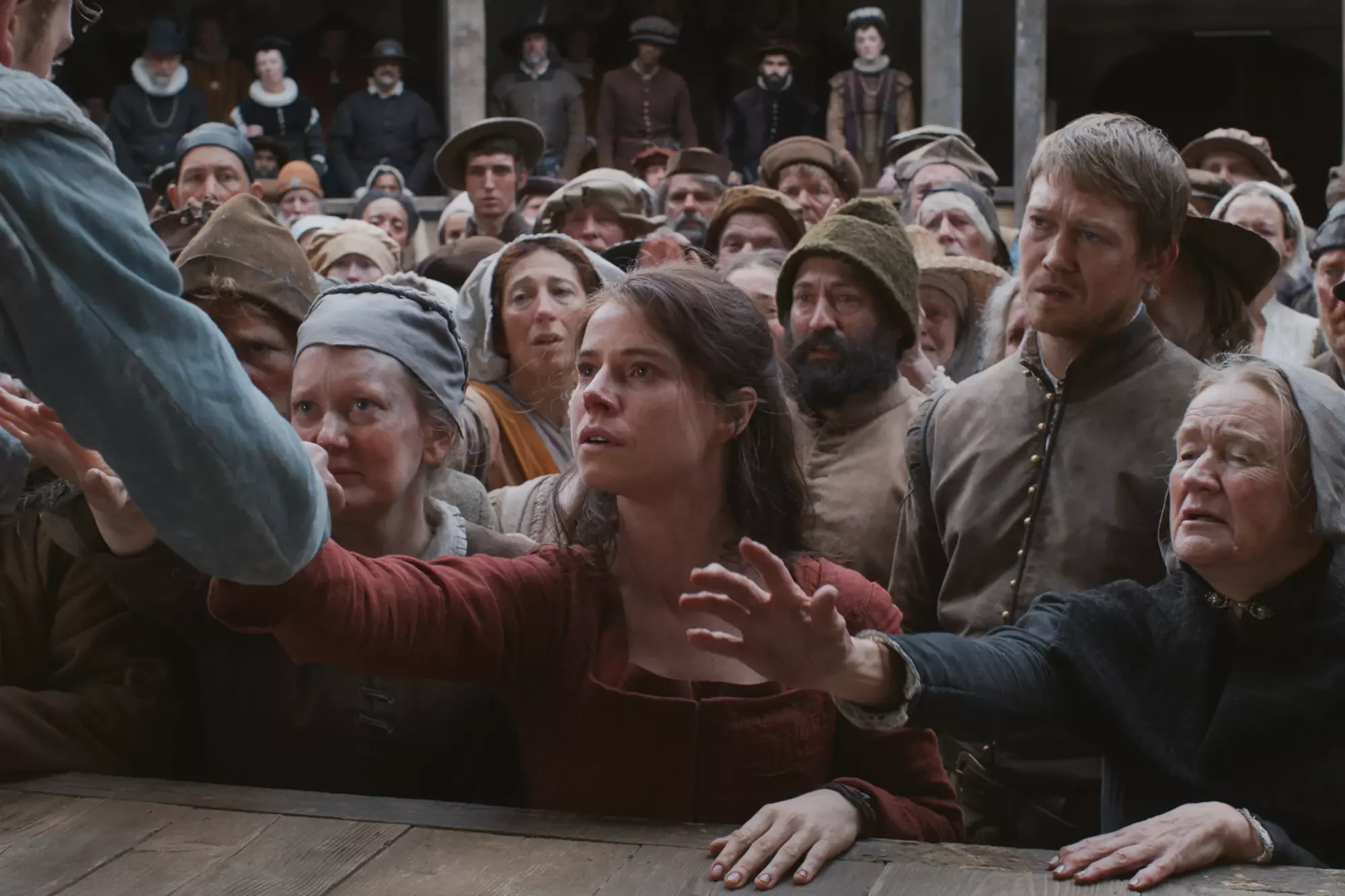
Hamnet (2025)
The dominant model of Western storytelling, the one Hollywood refined into a well-oiled machine, is essentially a structure for reliably triggering this cathartic function. Michael Hauge, who expertly breaks down the architecture of a successful screenplay, describes the story as a journey from safety to risk. A protagonist drawn out of their ordinary world by an outer goal, faces escalating conflict, arriving at a moment of full commitment that the entire story has been building toward. The character who began the story protected by a false identity ends it living as their true self, changed and confirmed by everything they've been through. Joseph Campbell, mapping the deeper mythological pattern underneath that structure, called it the Hero's Journey, the same arc recurring across cultures and centuries. What both are describing, ultimately, is not an invention but a recognition: that this shape (departure, ordeal, and return) is how human beings have always processed transformation. It is the structure of initiation, of grief, of falling in love. It is also the shape of a breath: inhale, hold, exhale. The audience is taken up and brought back down, and the release at the end is physiologically rewarding, like letting out a big sigh of relief.
Rather than dismissing the Hollywood model as mere formulaic manipulation, I would argue that at its best, it can perform an important societal role to great effect: the demonstration that human beings can find each other across damage, that wisdom accumulated through suffering can be transmitted from one generation to the next before it is lost. Films like Ordinary People or Moonlight use the cathartic structure not to entertain but to model what repair between damaged people can look like. They remind communities of their own capacity for tenderness, even amidst the common experience of turmoil. On the same token, an effective storyteller can co-opt the Hero’s Journey to portray a particular version of heroism engaged in a journey of questionable motives. And ultimately, along with the recognition of the stereotypical “Hollywood Ending” must come the acknowledgment that it is not the only type of ending that can exist.
The storyteller has never served only the audience's need for release. They have also served the community's need for warning, for protest, for the articulation of what cannot be said directly. Someone had to be the one to describe why the children should not wander too far into the forest, or what potential disasters the village should prepare for. That storyteller was raising an alarm, albeit in a format familiar to those expecting inspiration or entertainment. And in the same firelight, there were always other storytellers serving entirely different interests: those who glorified the chief, justified the hierarchy, made the current order of things feel not only inevitable but divinely sanctioned. Propaganda is not a modern invention. It is one of the oldest uses of narrative, and it has always existed alongside art that does exactly the opposite: that subverts, questions assumptions, makes the powerful uncomfortable with their own reflection.
When Tarkovsky made Stalker in the Soviet Union in 1979, filming under state surveillance on a budget the government controlled, he was not just making a film about a post-apocalyptic wasteland. He was re-creating the experience of limited artistic possibility under totalitarianism. There is a scene early in the film in which the three main characters ride a motorized trolley along a railway track into the Zone, the camera holding on them for several minutes while the landscape drifts by, the monotonous rhythm of the wheels on the rails providing the only soundtrack. Nobody speaks. Nothing happens. While watching it, I found myself drifting in and out of sleep, and couldn’t help but feel the experience was intentionally provoked. Tarkovsky was once told by Russian distributors that he should speed the film up. He responded that "the film needs to be slower and duller at the start so that the viewers who walked into the wrong theater have time to leave". He was essentially designing an airlock into the film's opening, a deliberate selection mechanism that filtered the audience before committing to the real experience. But he wasn't being elitist for its own sake. He believed that if the wrong kind of attention enters the room, it poisons the experience. The film requires a particular quality of presence from its audience, and the slow opening is a way of pre-selecting for that quality by the end of the film. "Never try to convey your idea to the audience,” he concluded, “it is a thankless and senseless task. Show them life, and they'll find within themselves the means to assess and appreciate it."
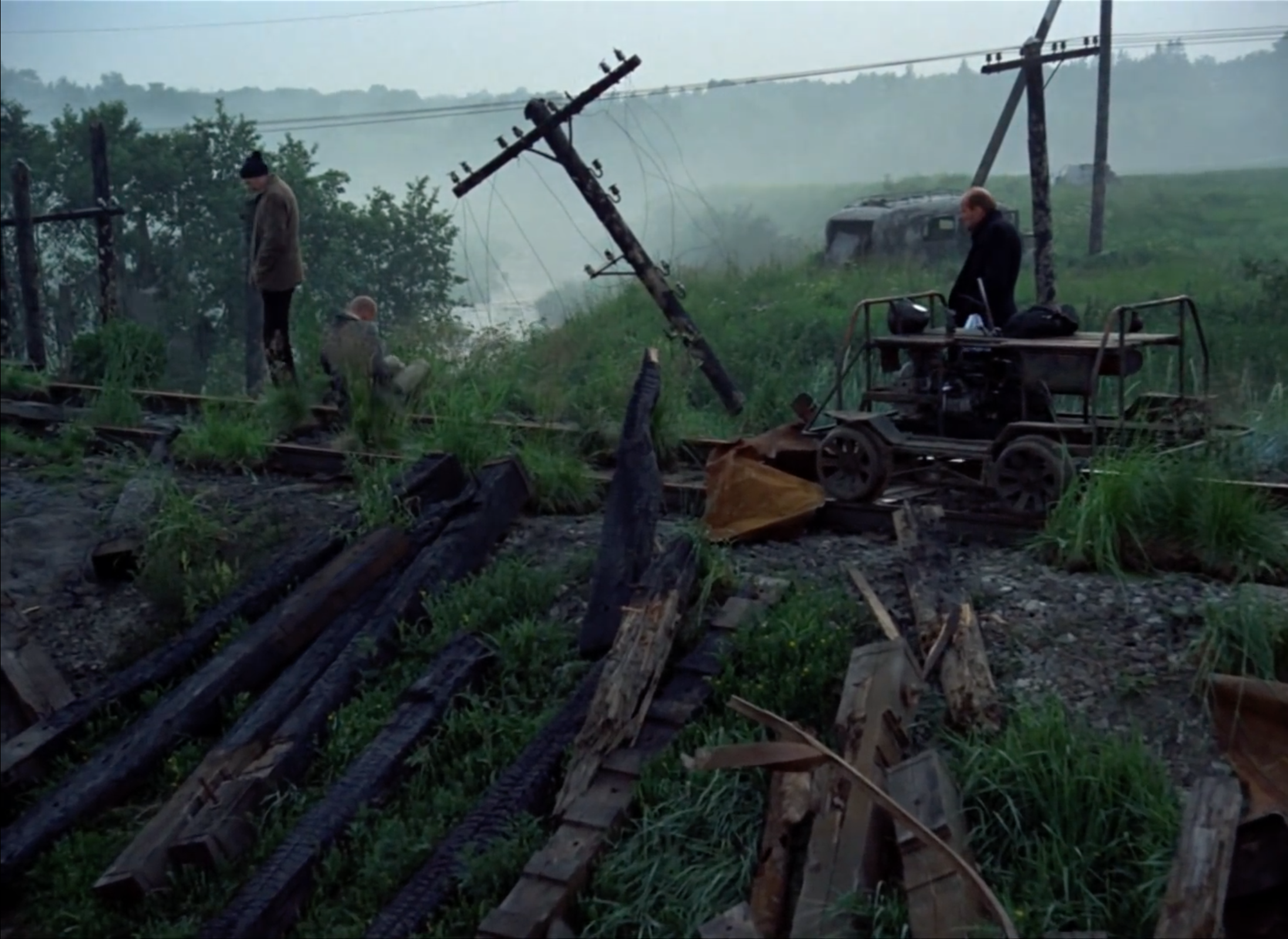
Stalker (1979)
In contrast, Hollywood was built inside a clear mythology of promise, expansion, and arrival. The American story, as a cultural narrative, is premised on the belief that forward movement toward a destination is both possible and redemptive. You leave the old world, cross the ocean, go West, find the land, build the life. The three-act structure is this mythology in miniature. The protagonist's journey is the pioneer's journey, the climax is the moment of arrival, the resolution is the settlement. Central to this is the engine of conflict: characters with opposing, individualistic objectives, whose collision drives the story forward until one force prevails. The antagonist is a person, or at least a personified will that can be faced, defeated, or succumbed to. Either way, the confrontation resolves. The feeling is discharged at the point of arrival, whatever form that arrival takes.
Genre in Hollywood is therefore less about emotional outcome and more about emotional contract. The audience arrives already knowing what kind of feeling they have agreed to have. A horror film doesn't end happily, but it resolves. A tragedy ends in death, but the death means something legible. A noir ends in corruption and loss, but confirms the moral universe in the process. The feeling may be negative but the transaction is completed. You leave having received what was promised.
Yet this other kind of cinema is built around a different tension entirely: not between characters with opposing objectives, but between a person and something that cannot be defeated or reasoned with. The environment, time, class, history, the nature of existence. These forces don't have objectives of their own that can be overcome through will, cleverness, or brute force. They simply are. Which means the protagonist can't triumph, can't arrive, can't resolve. They can only endure, or not. And the storyteller working in this register can't promise the audience a confrontation that clears the air, because there is only the pressure of circumstance, and the human being inside it.
Michael Haneke's Caché follows a Parisian television presenter who begins receiving anonymous surveillance tapes on his doorstep. Long, static recordings of the front of his house, shot from across the street. Then drawings, childlike and violent. The investigation leads him back to a suppressed memory involving an Algerian boy whose parents had been killed in the 1961 Paris massacre, and whom he had wronged in a way that altered the course of that boy's life. Despite surfacing this troubling past, Haneke never reveals who actually sent the tapes. The final shot is a long, static wide angle of a school entrance at the end of the day, crowds of children dispersing, and buried in the frame, barely visible, the two boys whose lives intersect at the center of the film's guilt are talking to each other. Most viewers miss it entirely, leaving the theater unable to name exactly what they felt, besides a confusing, emotional void. The reconstruction happens days later, upon a second viewing, or in the exchange of ideas with others. Haneke’s Code Unknown takes this denial of catharsis further as a principle: structured as a series of incomplete scenes, each one cutting away before their resolution, sometimes mid-sentence. The film's title announces from the outset that the codes by which we read social situations are simply unavailable. The incompleteness is an argument in itself, about how little we actually understand of the lives unfolding around us.
In 1975, Chantal Akerman made a film with a title as objective as can be: Jeanne Dielman, 23 quai du Commerce, 1080 Bruxelles. It is the name and address of the film’s protagonist: a Brussels housewife. Akerman makes you watch her prepare meals, clean, receive clients, in extended real time across three hours, until the accumulated weight of routine becomes unbearable. The tension is not between Jeanne and another person but between Jeanne and the structure of her own days, which the camera's patience makes suffocating, and that the editor's refusal to cut away transforms into something close to dread.
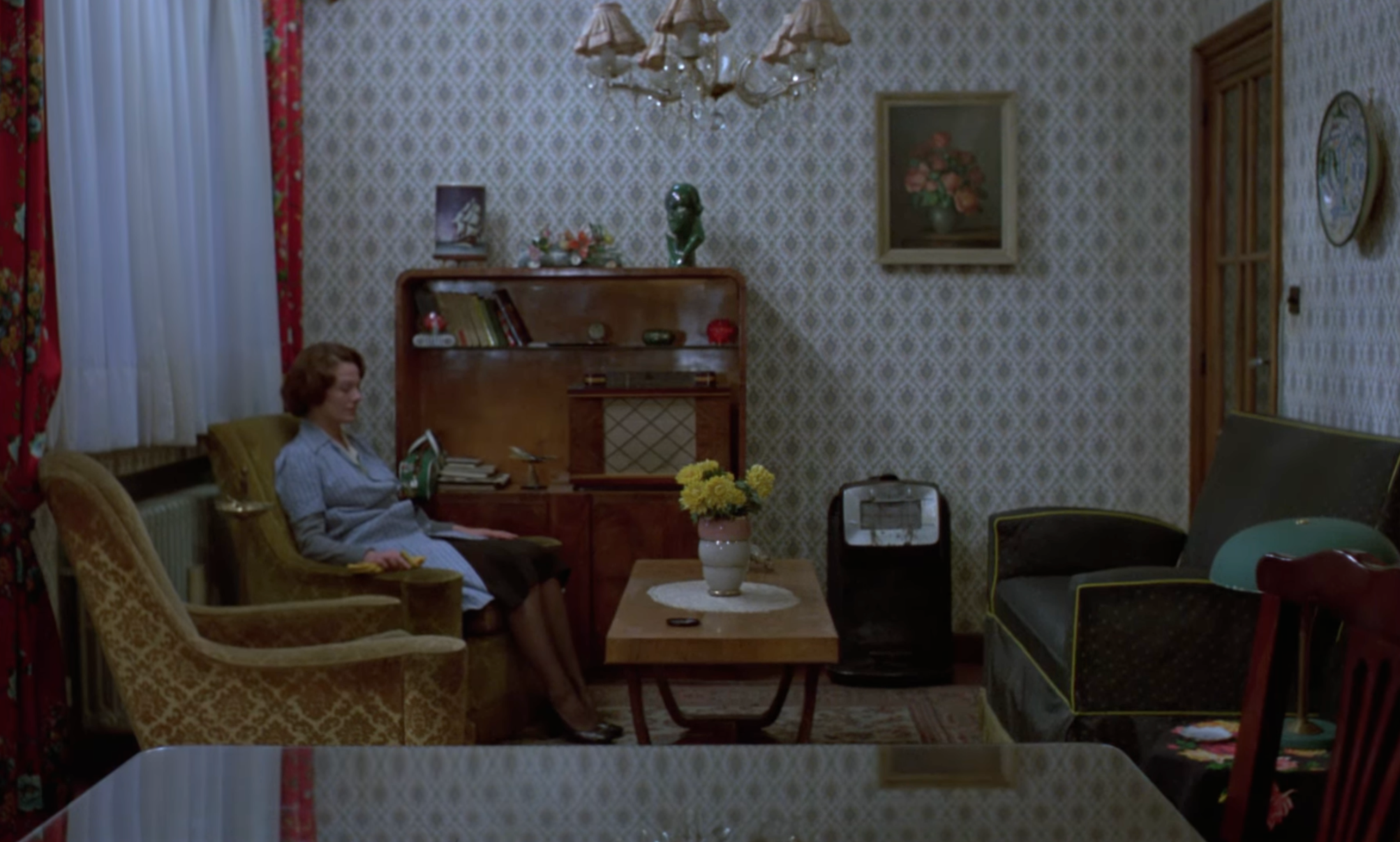
Jeanne Dielman, 23 Commerce Quay, 1080 Brussels (1975)
Abbas Kiarostami's Taste of Cherry, similarly slow-paced to the point of being hypnotic, follows a middle-aged man driving through the outskirts of Tehran, stopping to offer rides to strangers. He has a proposal for each of them: come to a specific hillside the following night, call his name, and if he answers, help him climb out of a hole he will have dug for himself. If he doesn't answer, cover him with the dirt piled beside it, therefore fulfilling his religious obligation to be buried after death. The film is almost entirely these conversations, shot in profile inside the car, each passenger deciding whether to participate or not. Then, after Badii finally finds someone willing to help him, and lies down in the hole, Kiarostami cuts away without showing us what happened. Instead, he shows video footage of himself and his crew on the same hillside, actors laughing between takes, soldiers marching in the background, uncomfortably and enigmatically drawing attention to the artifice of the filmmaking itself. The fiction is cancelled without explanation. What remains is the realization that the question of whether to stay alive was always yours to hold, and that Kiarostami refused to resolve it on your behalf. This transfer of burden and responsibility is in itself a challenge to a viewer accustomed to passively being guided through someone else’s choices and moral verdicts.
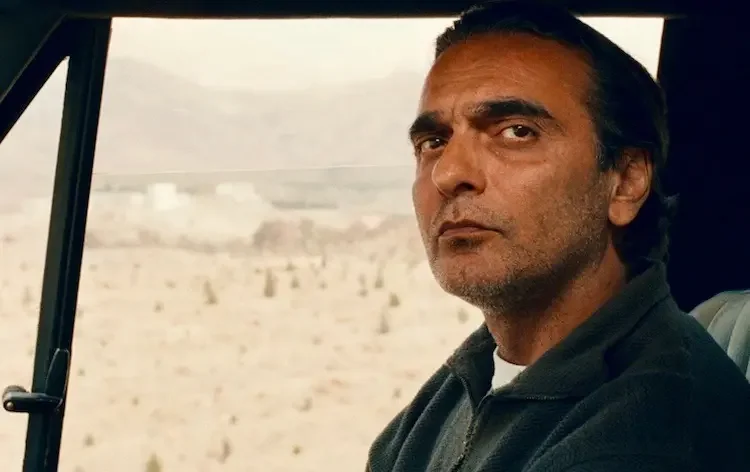
Taste of Cherry (1997)
Jonathan Glazer's The Zone of Interest achieves something gut-wrenching by a simple narrative choice not to show the Holocaust directly. The camera is mostly limited to the home and garden of Rudolf Höss, the real commandant of Auschwitz, while on the other side of the wall, audible but never visible, the extermination of over a million people is occurring. Glazer, a British filmmaker of Jewish descent, understood that depicting the horror directly would give the audience something to react against, a place to discharge their feeling. Keeping it offscreen forces the horror into a liminal space, much like Höss and his family members must do in order to continue serving their function with indifference. In one scene, children play outside as a train passes in the background — an image of complete domestic normalcy, until you recall an earlier scene in which Nazi officers discuss, in the tone of logistics managers, the most efficient way to move large numbers of “units” from one city to another. The banality of the family's domestic life is what you watch. The incomprehensibility of what surrounds it is what you carry out.

The Zone of Interest (2023)
In a similarly subversive way, Lucrecia Martel's The Headless Woman deals with the absence of consequence for a death that is never shown. It opens with boys playing beside a roadside canal in rural Argentina. Minutes later, a wealthy dentist named Verónica is driving alone when something thuds under her car. She stops, looks in the rearview mirror, and drives on. Whether she hit a dog or a child, Martel refuses to resolve by shooting from a distance. What follows is not a thriller about guilt but something stranger: Verónica moving through her privileged life in a state of dissociation, barely speaking, the camera pressing close to her face while the world continues around her. Her husband and male relatives quietly erase any evidence that an accident occurred, with the effortless efficiency with which the Argentine bourgeoisie has always managed its inconveniences. Martel has said that the accident is present in every subsequent scene in different forms — someone digging, something thrown to the ground — embedded so quietly that a mounting dread accumulates without a locatable source.
Ozu's Tokyo Story, made in 1953 in a Japan still absorbing the trauma of modernization and defeat, belongs to the cathartic tradition in form but pushes against it in feeling. An elderly couple travels to Tokyo to visit their adult children, only to find those children too consumed by urban life to make real time for them. The only person who treats them with genuine warmth is their widowed daughter-in-law, who has no biological obligation to do so. Ozu shoots from a fixed, low camera angle. Many of his scenes begin with an empty room and end with one — the human activity in between observed with the same patient neutrality as the silence that surrounds it. He never tells you how to feel about what you're seeing. He doesn't underline grief with music or linger on a face to cue your tears. He simply places the camera and trusts the situation to do its work, which means the emotion arrives entirely on your own terms, if it arrives at all.
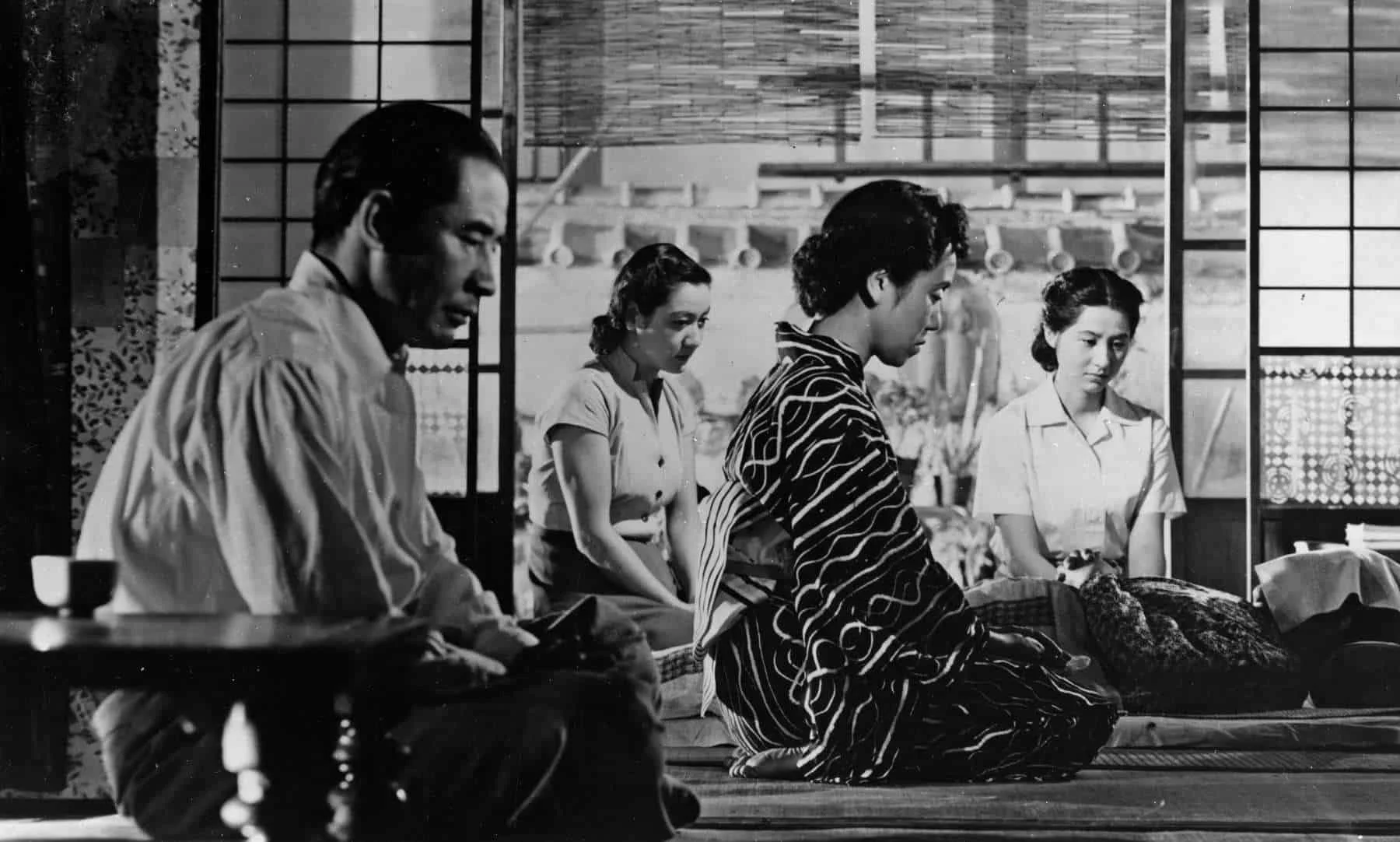
Tokyo Story (1953)
These storytellers who refuse the traditional delivery of catharsis have found alternate ways of bringing people into contact with what is true. They work with implication, with the unsaid, with the image held longer than comfort allows, with the ending that isn't a concrete plot point. But this is a choice with deeper implications than just aesthetic differentiation.
The village model of storytelling served a world where the threats were visible and the community was small enough to be shepherded. The authority of the chief, the elder, the storyteller, rested on the fact that they had seen more, survived more, and could package that experience into a form the community could absorb and act on. Catharsis told people what to feel, and in doing so, told them who they were and how to behave within a group that would shelter and protect it from outside threats. But we no longer live in that world. The forces we are up against now have grown beyond the boundaries of the forest and are all-pervasive. Mass media, algorithmic manipulation, the industrialization of attention, these have all become threats, not just to the survival of the body, but to the survival of the mind. A film that tells you what to feel and when, that resolves its tensions cleanly and sends you home with your emotions neatly discharged, is not a neutral act in this environment. It breeds complacency.
Consider the ways each of the films mentioned here break narrative norms as an act of defiance. Caché forces a white French intellectual — and by extension French society — to confront the buried violence of the 1961 Paris massacre, an atrocity the state had spent decades refusing to acknowledge. Code Unknown makes its fragmented portraits into a political argument: the codes are unknown because the dominant culture has never bothered to learn the full story of the immigrant lives unfolding alongside it. Jeanne Dielman makes you watch for an unbearable amount of time what society systematically looks away from — the unpaid, unacknowledged labor of a woman's constrained domestic life. Taste of Cherry surreptitiously spends ninety minutes having a conversation that is religiously forbidden in the country where it was filmed. Stalker was made under a system that surveilled its artists and demanded ideological compliance, and so Tarkovsky buried its message deep in procedural tedium, so as to repel its potential ideological critics. He has described the Zone depicted in the film as a space where the deepest and most honest part of a person is exposed, where self-deception becomes impossible. In that sense it is the condition of being fully, vulnerably present, a state which the filmmaker ultimately demanded of its own viewers. The Headless Woman depicts a milieu with a long history of making inconvenient things disappear, and Martel refuses to resolve the accident at its center because in the world she is depicting, resolution is frustratingly impossible. The Zone of Interest implicates not just the Höss family but every society that has ever arranged itself to keep horror on the other side of a wall. And Tokyo Story quietly refuses, through its own filmmaking form, the ideology of incessant forward movement that severs people from their parents and calls the severing inevitable.
The films that accomplish this delayed catharsis are not just breaking convention, they are re-training human consciousness to transcend the boundaries of its own understanding of the world. It is forcing an independent thought process that equips people to investigate truth independently. It treats a viewer not as a consumer of experience, but as a co-creator of it. It plants the seed of a story, and then sets you free to let it grow into your own.