I didn't expect Contact, of all films, to still have a trick left to play on me. I’ve written about it before, I've watched it more times than any other movie I own, and a few weeks ago, without warning, it turned itself inside out in my head. And what I saw was a completely different machine.
I think the reason Contact has stayed with me for twenty-eight years is that it was never really a film about aliens. It's a film about the oldest question we have, dressed in a lab coat: what is out there past the edge of what we can know. And will we ever know? Every civilization has told some version of the same story. Someone crosses the boundary of the known world, goes to the one place nobody else can reach, and comes back with a report. Gilgamesh, Odysseus, Dante, the shaman who returns from the spirit world with an answer for the tribe. Contact just tells that story with a radio telescope instead of an underworld, and its real subject is what happens to a person, and to a civilization, when that ancient myth actually comes true and nobody can verify it. What I think I finally realized, turning the film over again after all these years, is that someone in the film understood this too, maybe better than the film ever says out loud. Someone who knew exactly what it would mean to hand someone that myth personally, and then let the rest of us watch what she did with it.
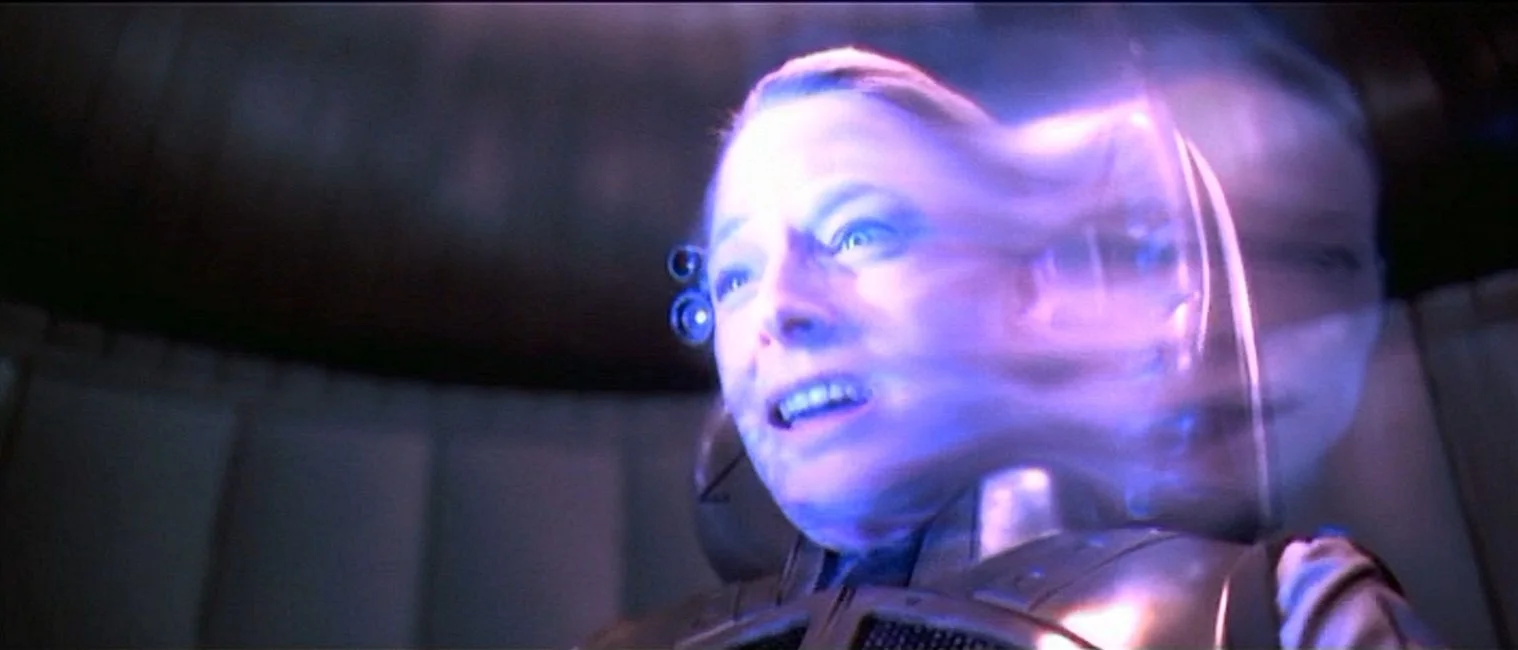
Here's a quick recap. Ellie is a radio astronomer who spends years listening for a signal from deep space while everyone above her dismisses the search, including her superior David Drumlin. When Ellie finally picks up a signal (a message from Vega, encoded with the blueprints for a machine), the discovery gets credited to Drumlin the moment there's a White House briefing to give. The machine gets built, but Ellie loses the committee vote to decide who goes, largely because Palmer Joss, a religious writer she's fallen for, asks her on the record whether she believes in God, and she won't lie. Drumlin gets the seat instead. On the day of the first launch, a religious extremist gets through security and blows the whole thing up, with Drumlin in the machine. Only afterward does the world learn a second machine exists, built in secret, and Ellie is chosen by default to enter it. She experiences what reads, to her, as an eighteen-hour journey through a wormhole to a beach where an entity that looks like her father tells her simply that she is not alone in the universe. Ellie falls back through the machine in under a second by everyone else's clock. Her camera records nothing but static. And in a closed hearing afterward, with no evidence to offer, she tells Congress the truth: it was the most profound experience of her life, and she cannot prove any of it happened. But Palmer Joss and the faithful of the world believe her.
That's the film as I understood it for twenty-eight years. Real aliens, genuinely orchestrating the whole encounter, choosing to appear to her in the image of her father because looking at them would be unbearably shocking. And the rest of the world’s skeptics vehemently opposing her testimony out of cynicism. Here is the version I can't shake now: what if none of it happened, and it was never supposed to? And I think this makes it an even better film.
Start with S. R. Hadden. He is the one who funds Ellie specifically, for years, quietly, when no one else will. He is the one who invites her onto his private jet and shows her, across a wall of screens, everything he's compiled on her: her history, her research, her father’s encouragement of her interest in the stars. When the world’s leading cryptographers get stuck trying to decode the alien language the instructions were written in, Hadden is the one who apparently cracks the code, and leaks it to Ellie. “Once upon a time, I was a hell of an engineer,” he says, then allows her to take credit for the discovery.
By Ellie's own stated logic of Occam's Razor [the simplest explanation is usually the right one] which is more likely: that a reclusive billionaire who happens to be her financier outpaced every codebreaker on Earth, or that he already had the answer and waited for the right moment to hand it to the one person he needed to have it? The game master, giving away a cheat code to his favorite player when the others weren't solving the puzzle fast enough.

Everything about Hadden's presence in this film is structured like a man managing an outcome from behind a curtain, and once you notice that the film never actually disproves it, you start asking what outcome he might have been managing, and why its main protagonist had to be Ellie.
Because that's the real question underneath all of this, and it's the one I hadn't actually sat with before: why Ellie, and not Drumlin? If the point was simply to get someone into a machine and see what came back, Drumlin would have sufficed. He was, after all, the one the committee actually chose. I think the answer is that Hadden never wanted a report. He wanted an experience, and you cannot manufacture an experience for a man you haven't spent years quietly researching.
When Ellie asks her father at the beach, “why did you contact us?” he responds, “You contacted us.” I never understood this, until you put into context that the “us” is whoever designed the machine. And the scene in the private jet could be one answer to that question. That wall of screens is a man showing his work, the way you'd show your work on anything you'd spent a decade building. He didn't have a file like that on Drumlin. He had one on Ellie, because she's the one who came to him for money in the first place. He didn't seek her out, she sought him out, and I think that's the detail that actually starts the whole thing. She presents to him her life's work and her reason for doing it, and somewhere in that presentation, an idea occurs to him that goes well past funding: what if I don't just pay for her search. What if I give her what she's searching for. And that became his life’s work.
And it has to be her rather than a religious person for a reason the film already argues, just aimed differently than I'd noticed. A devout person who comes back from a machine saying they saw proof of God in their father’s ghost has told us nothing we didn't already expect them to say. It's their whole vocabulary, and the world discounts it accordingly, believers nodding along and skeptics rolling their eyes, nobody's mind changed. But a lifelong empiricist, someone who has spent her career refusing to believe in anything she can't measure, coming back and saying I encountered something I cannot explain, and it had no reason to look like anything, and it chose to look like the one thing I could never have back — that testimony is credible precisely because she has nothing to gain from giving it. She's not auditioning to be a prophet. The religious get their vindication and the scientists get a witness with no motive to lie, and both camps hear it from the same mouth. That, I think, is the actual design: not proof, but a witness whose credibility comes specifically from having no interest in being believed.
Which brings me back to the committee, and why I think Joss's question is the real hinge of the film rather than a moment of romantic tension. Nobody has ever asked an astronaut whether they attend church before clearing them for a mission. It's never been a criterion, and making it one here cost Ellie her seat. Yet the only reason Palmer Joss ever brought it up, by his own admission later in the film, was because he didn’t want her to leave him for a journey she may never come back from. Love was the anomaly in the plan, veering it off Hadden’s predetermined course.
Drumlin gets the seat by performing an answer he doesn't sincerely hold. And once he's in that machine instead of Ellie, the machine isn’t carrying the passenger the experience was built for. In this viewing, the exploding machine starts to look less like a tragedy, and more like a plan cleaning up its own mistake, the only way it still could. And it wouldn’t suffice to destroy the machine in an apparent accident, with Drumlin in it. The designer had to ensure another Drumlin wouldn’t take his place.
Which is where the man with the bomb comes in. Security around that launch is described, more than once, as the tightest ever assembled for anything on the planet. A visibly unstable extremist, who’s seen lurking around menacingly at public protests, does not infiltrate a perimeter like that. He's let through it. And the confession tape that plays on every channel within hours puts a definitive face on the catastrophe. “This won’t be understood, not now,” he says, before evoking faith as his primary motive.
I don't think the point of that attack was to discredit religion in the abstract. I think it was narrower and smarter: to discredit the specific mechanism that had just put Drumlin in Ellie's seat: a selection process vulnerable to religious optics. Not by causing the attack, exactly, but by making sure that whoever's face fills every screen at the moment of catastrophe is a man loudly, visibly acting in the name of God. After that footage runs, nobody in a position to choose the next astronaut wants to be seen weighing religious conviction as a qualification. Whatever the actual chain of causation was, the association alone is now radioactive. Ellie's refusal to perform belief, the very thing that cost her the first seat, becomes retroactively the only defensible position for the second one, not because anyone proved faith caused the bombing, but because nobody wants to be the next person on television standing anywhere near that question.
And there's a second, quieter idea sitting inside this one that I think the film means for us to notice and never resolve. Ellie states during her debrief that nothing in Vega's transmitted blueprints specifies a chair, a suicide capsule, or a camera. Those get added by the engineers building the thing, worried and improvising, and it's that structural addition that causes the violent shaking Ellie experiences during the journey. If the humans are already botching the machine's construction in ways the original design never called for, then Drumlin sitting in the wrong seat is the same kind of error, playing out one level up.
There's a character in this film that also gets to be seen under a completely different light in this interpretation. Michael Kitz, the National Security Council advisor played by James Woods, spends the entire film as the person most suspicious of Ellie, most insistent on treating the machine and the message as a security threat rather than a wonder, and I always took him for exactly what he appears to be on the surface: a cynical, turf-guarding bureaucrat trying to discredit a discovery he doesn't have the imagination to appreciate. But he's also the only person in the film who asks the plainest, most necessary question any honest investigator asks of a miracle: are we certain this message came from light-years away, or are we only certain it came from somewhere we haven't yet ruled out being much closer to home? That's not cynicism. That's the report any competent inquiry produces once it actually follows the paper trail instead of accepting the story at face value. I spent a quarter of a century reading him as the film's answer to Palmer Joss's faith — the small, fearful man who can't accept the miracle — when he might just be the film's other scientist, running the same rigorous doubt Ellie built her entire career on, and arriving, entirely reasonably, at a different conclusion than she does.
There's a pattern in how this film shows us everything, once you start looking for it, and it's worth pausing on before we get to Ellie's own tape. Drumlin dies inside a burst of security-camera angles, one feed glitching into the next, so that even his death reaches us as a broadcast rather than as something witnessed. The public reaction, the negotiations, the press conferences, the entire climate of the country, comes to us mostly through news coverage on television screens inside the film, a frame within a frame. Even Contact regularly hands you someone else's feed of the thing happening, until you've stopped noticing you're one step removed from the source. That's not incidental style. It's the film training you, scene by scene, to accept a mediated experience as equivalent to the real thing — which is exactly the trust the ending needs from you when it finally hands you eighteen hours of static and asks you to decide, without ever having seen the source yourself, what it's supposed to prove.
I used to take the eighteen hours of static as evidence, something the film was offering us as the only detail that survives scrutiny. I don't think it's evidence at all. Think about landing after a long flight where you slept through most of it. Nobody wakes up and says "I remember the flight being eighteen hours long," you check a clock and add the numbers. I think that's exactly what Ellie does with her own camera. She isn't lying, she's doing arithmetic with the only clock available to her, and it happens to be a clock somebody else could have easily set. Just like Drumlin's appointment, and the safety chair clumsily installed, a video recording device was an unexpected liability in Hadden's plan, and the only way to neutralize it wasn't to destroy it. Smashing or wiping a camera off a supposedly effortless crossing would be its own kind of evidence, evidence of tampering rather than evidence of nothing. And a camera that came back with an hour of footage, or thirty seconds, or a length that didn't line up with anything, would be a device actively contradicting her account, in her own equipment, on the record — a much harder thing to explain away than static. So the safer move isn't erasure, it's substitution: eighteen hours of recorded nothing, either transmitted onto the drive over however long the pod is actually running, or unlocked off a delay the moment she's pulled out, engineered to match a length rather than to confirm one.
And here's where I genuinely don't know which direction the causality runs, and I don't think the film wants me to. Did Ellie live through what felt like eighteen hours and then check the camera afterward, and find a number that happened to agree with her? Or did she check the camera first, in that first disoriented hour back, find eighteen hours of static staring back at her, and only then arrive at the figure she now reports as her own memory of how long she was gone? Either order produces the exact same testimony. She isn't choosing to lie in either case. She's simply the one person in the room who can no longer tell whether she remembered the number or borrowed it, because by the time anyone thinks to ask her, the two have already fused into a single fact in her own head.
Watched that way, one of the last, quiet exchanges in the film land in a way I'd never caught before. When the Chief of Staff, played by Angela Basset, discusses the tape with Michael Kitz, she says she finds it interesting that the recording was 18 hours long. “That is interesting, isn’t it?” he responds. I used to hear that as one person uncovering the film’s only confirmation that Ellie’s story is true, and the other person admitting their own oversight of that detail. Now I hear two people that feel confirmed, but for two completely different reasons. Kitz sees planted evidence, and an accomplice willing to defend it.
There's an even simpler version of the machine's designed experience that doesn’t need elaborate virtual displays at all: a sealed chamber, controlled temperature and pressure, and the right cocktail of compounds released into the air she's breathing. Hadden wouldn't have needed to manufacture Ellie's father at all. He'd only have needed to get her alone, with the cameras disabled, and let her own mind do what minds already do under the right chemistry. The elaborate wormhole effects, the conversation at the beach, could be nothing more than a show for us, the audience, dramatizing an experience that from the inside was never anything but Ellie's own brain, finally allowed to say what it had been carrying the whole time.
There's one more image from the crossing itself I keep returning to: partway through the travel, Ellie looks to the side and, for just a moment, appears to notice the seams of the experience she's inside — scaffolding, structure, the visible machinery behind an illusion that's supposed to be seamless. That could be a peek behind Hadden’s curtain, but it could also be Ellie’s own scientific mind, the part of her that has spent a career refusing to take anything on faith, intruding on an experience built to bypass exactly that instinct. The momentary questioning, “am I in a dream?” Whether that flicker is proof the whole thing was engineered, or simply what skepticism looks like from the inside a spiritual experience, is a moment in the film that argues both sides of my theory at the same time.
And the final thing I can't answer is what Hadden actually wanted to happen. Maybe he built a specific outcome and got it: a scientist returns transformed, offering the world permission to hope without asking anyone to abandon reason to get there. Or maybe there was no fixed outcome at all — maybe the entire thing was an experiment in the truest sense, and what he actually wanted to know was simply how humanity would react. Would we build the machine at all? Would the person we sent come back and say nothing happened, or lie and say something did, or come back transformed by a dream or hallucination, and unable to prove it either way? Would that lack of proof unite us or fracture us further? Would the money and the labor and the improbable global cooperation it took to build the thing point toward something like peace? Or towards what Hadden gestures when he says “they still want an American to go” — the same appetite that once decided who got to plant a flag on the moon first. I suspect even he might not have known which outcome he was hoping for until he saw it.
And that’s also the reason, I think, that this experimental machine had to be built to look like technology nobody on Earth actually understands, rather than technology we simply hadn't gotten around to inventing yet. If Vega's blueprints had described something recognizable — a better engine, a sturdier alloy, a faster processor — the world's own engineers would eventually be able to tell you exactly what it did and how, and that kind of certainty is the one thing this device can't survive. Being genuinely alien, meaning built on principles nobody involved in constructing it can verify or explain, is what lets it double as anything at all: a wormhole generator, if you want to believe that, or an extraordinarily sophisticated chamber built to simulate one, if you don't. Nobody on the construction team can rule out either reading, because nobody understands the machine well enough to rule out anything.
There's a scene early on, before anyone's actually built anything, where officials sit around hypothesizing what the machine might turn out to be — a weapon, a Trojan horse, a tool for advancing humanity. What strikes me now is that the film never picks one of these and discards the rest. Every scenario they float stays technically possible, because what the machine actually turns out to be depends less on what it is than on what humanity chooses to do with it once it exists.
There's also a more practical reason the whole design depends on nothing coming back that can be verified: if Ellie returned with proof — actual, undeniable proof — the story stops being a story and becomes a queue. A government doesn't get to have a single verified crossing to another civilization and quietly shelve it. Every nation with a treasury would want its own passenger. Every scientist who ever doubted her would suddenly need a turn. The whole arrangement — one machine, one seat, one witness whose word is the only evidence there will ever be — only survives as long as it stays unrepeatable. Proof would have ended the experiment in its first week, buried under exactly the kind of scramble for access that no single government could contain or justify denying to anyone else. An unprovable miracle judged by the authorities as a hoax can be witnessed once and left alone. A verified one gets nationalized by sunrise.
And I think that's also why the machine itself is built as a circle instead of pointed in any direction. A road has a destination — you can walk it to the end and arrive somewhere. When roads were all there was, we used to think the world ended at a cliff. When flight became possible, we thought the heavens themselves were the destination, a place you could point at and eventually reach. Now we've mostly given up on the idea of a destination at all — the road, if there is one, turns out to be a knot nobody can fully untangle, not a line running toward an answer. A machine shaped like a circle isn't traveling toward anything. It's the design admitting, quietly, that the truth it's chasing was never going to be arrived at. Only circled.

Which is maybe why the device doesn't launch her away at all. It takes her in. A circle is also an eye, and this film opens on one: the famous unbroken shot pulling back from Earth through the entire visible universe, and then comes out the other side on Ellie’s eye as a child, with a reflection of the machine on it. We make contact through our eyes. Through what we witness. She is working a ham radio for the first time. I also don't think that moment in Ellie’s childhood is incidental. I think it's the actual destination the machine was built for. What Ellie sees when she looks into the machine isn't a beach eighteen light-years away. It's herself, as a child, the night she first reached into the dark and got an answer back from Pensacola, Florida. You have to know yourself before you can claim to know anything past yourself — that's the order of operations this film insists on, gently, without ever saying so out loud — and the machine, for all its scale and expense, exists only to put her back in that room. Ellie’s journey is a microcosm for humanity’s journey. Humanity must know itself before meeting its Maker. Every act of discovery of the natural world is both expansion and introspection.

Earlier in the film, Ellie asks Palmer Joss whether it’s more likely that God exists but didn’t give proof of His existence, or that we created Him so we wouldn’t feel alone in the universe? The film doesn’t attempt to answer that, as much as tell us that it doesn't actually matter which version is true. Ellie says as much herself, on the stand, under oath, without anyone forcing her to: “is it possible that it didn't happen? Yes.” She says it as the truest thing she knows. The film was never trying to prove her experience was real. It was showing us what happens to a person who has one anyway. She experiences grief in a shape she can hold. Her dead father’s scattered popcorn on the floor become shiny grains of sand in his hand, and then appear in Ellie’s hand when she returns from the journey and sits by the Grand Canyon. Understanding arriving dressed as the thing you miss most, with absolutely nothing you can carry back to prove it to anyone else. She carried back grains of sand that shine in a particular pattern only she can see because only she remembers what the popcorn looked like after her father fell. Whether that shape came from a wormhole eighteen light-years out or from a very rich, very patient man who read her case file and built her a beach and her father out of it, the experience did the same work on her. It changed her the same amount. It cost her the same thing, which is certainty, and it gave her back the same thing, which is peace with not having it.
And none of this makes the film feel colder to me, although I could see how it might land that way. Find enough wiring behind a magic trick and the awe usually shrinks. This one doesn't for me. If anything, running the theory all the way through made me trust the ending more, not less, because I think belief in a Designer actually works best when not one absolute interpretation of something, but a myriad exist.
Ellie's proof doesn't arrive labeled. Nobody hands her a pamphlet explaining what she saw. She's given an experience shaped entirely by her own grief and has to decide, alone, with no authority confirming or denying any of it, what it means and whether to trust it anyway. That absence of instruction is what makes the belief hers instead of someone else's, handed down. It's also, I think, the truest thing the film has to say about faith in general: it holds up better as something a person arrives at than as something delivered to them fully formed.
All of this gives whole new meaning to the line Ellie’s father says at the beach. “In all our searching, the only thing we found that makes the emptiness bearable, is each other.” I used to hear that as a line about first contact. I think "each other" means the person right next to her in the end of the film, whose nearness she kept avoiding. I think “each other” is also what it always means, spoken from a parent to a child. And behind that parent, which one’s speaking? God, an alien, or an old dying billionaire trying to leave the world the grandest epitaph in history. Regardless of whose message it is, these are some of the last words we hear before we see Ellie back on the floor of the machine again. Whether the film simply doesn’t show us, or she doesn’t remember traveling back, we’re not told.
That, I think, is the real trick Sagan pulls with this story, and Zemeckis with the filmmaking. It’s the reason Contact survives twenty-eight years of me trying to decipher it. They built a story where the mechanism underneath the miracle is genuinely, permanently undecidable — where you can go looking for the wiring, find quite a lot of it, and still end up exactly where you started, because the wiring was never the point. Whatever's out past the edge of what we can verify, we keep receiving it back in the shape of the thing we lost. I don’t know what I would get. But like Ellie, I can just keep listening — and, apparently, keep looking for the wires, because the film has room for that too, and doesn't flinch when you find some.